

Do you have a junior rockhound . . . and a budding collection of colorful stones and minerals?
A lot of collectors love finding different kinds of rocks. There’s that squarish bit of pyrite, or the rose-shaped gypsum, or the semi-translucent chunk of obsidian. Thundereggs, agates, quartz—they all have cool names and they’re shiny.
I personal find it fascinating to see how many different shapes and colors rocks can have. (In fact, I even wrote a picture book, Can a Rock Grow?, to explore some of these different shapes!)
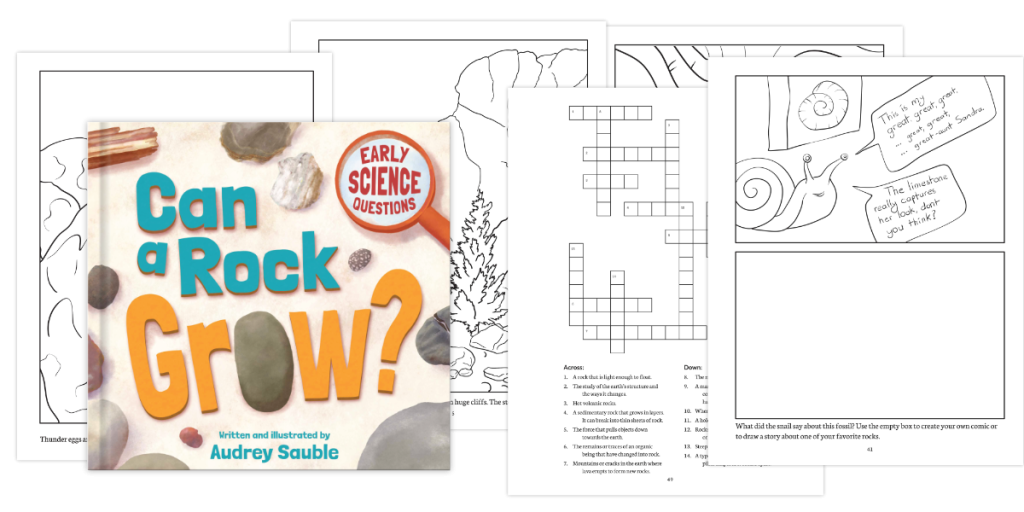
Calling all young rockhounds!
Sign up now to get activity pages for Can a Rock Grow?!
But what about useful rocks?
Throughout history, humans have used rocks for building, for hunting, and even for trade.
In my previous post, I mentioned my family’s rockhound neighbor, back when I was a kid. This neighbor taught one of my brothers how to polish rocks. He also introduced my family to a variety of different types of rocks.
One of those rocks was obsidian.
Obsidian has fascinated me ever since then—it’s a rock, but it’s also glass?
And, as I learned more recently, obsidian isn’t just a plain, black, glassy rock. It can have snowflake patterns or rainbow colors. Because it is glass, obsidian breaks in a curving “conchoidal” fracture.
And because it breaks into pieces with thin edges, it’s been used to create knives, arrowheads, and other sharp tools.
Rocks like obsidian were one of the first materials that humans used to make tools. Humans have used rocks for many other purposes as well.

Check out this list to see how people have used rocks. (And in some cases, we continue to use rocks to this day!)
Ways to Use Rocks:
- Rocks can be tools—humans have used rocks as knives, hammers, and axes. We’ve used them as mortars to grind food, and as many other kinds of tools.
- Rocks can be landmarks—mountains, boulders, and other unusually shaped rocks have helped people mark trails all around the world. (If you grew up playing Oregon Trail, you probably remember passing Independence Rock and Chimney Rock along the way!)
- Rocks can be a sacred area—not all landmarks are sacred areas, but many cultures revere certain landmarks as special places. Some of these rocks include Uluru in Australia, the Black Hills in South Dakota, and the Temple Mount in Jerusalem.
- Rocks can be monuments—cultures from around the world have used rocks to build monuments. We’ve used rocks for statutes, temples, and other structures to commemorate their rulers or major events like battles.
- Rocks can be records—one of the most well-known historical records is the Rosetta Stone. This stone records a legal decree in three different languages. An early linguist used the languages on this stone to decode the secret of hieroglyphs.
- Rocks can be a canvas—ancient humans used rocks as a canvas to create cave paintings. Other cultures carved petroglyphs or recorded human hand prints on rocks. (See this activity to create your own cave painting!).
- Rocks can be a home—from European castles to Anasazi cliff dwellings, people have used rocks as building material. Even today, architects design modern buildings with marble facings or other stones.
- Rocks can be barriers, or bridges—as a building material, rocks have been used to connect or divide. Stone structures include the Great Wall of China and the Bridge of Sighs in Venice. Farmers used stone to build walls around pastures and fields. Today, stones are still used around the world to build backyard terraces.

- Rocks can be a game—ancient games like Mancala and Go used stones as their playing pieces. Anyone with a supply of small stones can create their own set to play these games.
- Rocks can be mosaics—early pavement mosaics often used pebbles in different colors to create patterns. Some pavements even showed events or figures from mythology.
- Rocks can be ornaments—throughout history, people have used precious gems and semi-precious stones to decorate jewelry or other ornaments. In some cases, these ornaments were even used in place of money.
- Rocks can be tools for cleaning—washing up with a rock seems strange now. But, rocks have been used for cleaning throughout history. In the Philippines, panghilods are smooth scrubbing stones that may be used bathing or for exfoliating.
- Rocks can be history—records like the Rosetta Stone can be used to decipher human history. Geologists also use natural rock formations to uncover the Earth’s history. Fossils can show the history of life here on Earth.
- Rocks can be warmth—coal is fossilized plant material. When coal is burned, the rock is transformed into heat. We can use this heat to warm a house or produce electricity in a power plant.
- Rocks can be a gift—ancient kings used diamonds and rubies to reward their followers. Even today, we share gifts as simple as a painted rock or a chunk of mica from a special hike.

Ready to use some rocks yourself?
Most of us won’t build rock walls or castles. There are still plenty of fun crafts and kids activities you can do using rocks! Try one of these activities today—use them to plan geology party, including with a rock-themed snack!

Melted Crayon Rocks:
Painted rocks are very popular now, but melted crayon rocks is a fun variation on that project. For this project, start by warming the rocks. Then, when kids color on them with a crayon, the crayon will melt from the heat.
We warmed our rocks in the oven with the temperature set to low. (Overheating rocks can cause them to explode, so this can be dangerous). Left Brain Craft Brain suggests using a candle warmer instead.
Since the rocks will be warm, your kids can use a rag or an old glove to protect their fingers. Use beeswax crayons to create a biodegradable art project. Or, use any wax crayon and can coat the rock with collage glue to protect the colors.
Rock Games:
Mancala is a two-player game that starts with groups of stones arranged in two rows. You can play this game outside with gravel, digging small holes for the pockets. Or, you can use your kids’ rock collections and adapt an egg carton to hold the stones. For this version, use the instructions from Math Geek Mama.
For a different game, play tic tac toe with stones painted with two different colors or patterns. Use this bees and ladybug set from Red Ted Art as inspiration!
Soap Carving:
Soapstone is a popular material for rock carving, since its soft and easy to work. Carving soapstone takes a special set of tools, though. Worried that your kids aren’t ready to use sharp tools yet? Use a craft stick to carve a bar of soap, as suggested by There’s Just One Mommy.
Rainbow Rocks:
Next time you explore a beach or another area with lots of small stones, look for different colors. Challenge your kids to see how many colors they can find. Use these rocks to create a rainbow (or even a mosaic). This is a fun way to compare colors and notice just how many different colors rocks can be.

Plan a Rock Party!
Invite some friends over to try out one or more of the activities. Then, when all the crafts and games are over, celebrate with with a rock-tastic treat! There are plenty of different ways to show the rock cycle. Elementary Shenanigans uses rice crispy treats, smores, and chocolate sauce to show how sedimentary, metamorphic, and igneous rocks form.
Want to add a geology flair to your party? Break open a geode, or grow your own rocks! You can find other fun science activities and more in my blog post about doing science with rocks.
Most of these projects use common household supplies. They’re very easy to set up and will help kids explore how rocks change.
Or, maybe you want to add a literary element to your rock party! My picture book, Can a Rock Grow? introduces young readers to the rock cycle. It shows different ways that rocks change over time, as well the different shapes and colors that rocks can be.
And be sure take a closer look at your own rock collection! Who knows what colors and shapes you’ll find there!

UPDATE May 2026:
Coming August 2026! Can a Rock Grow?
I’ve been working on some earth-shaking updates to Can a Rock Grow? (Or, at least some fun changes!) This book is a unique look at the rock cycle.
It helps kids explore geology and learn more about some fascinating stones.
Leave a Reply