

UPDATE May 2026:
Coming August 2026! Can a Rock Grow?
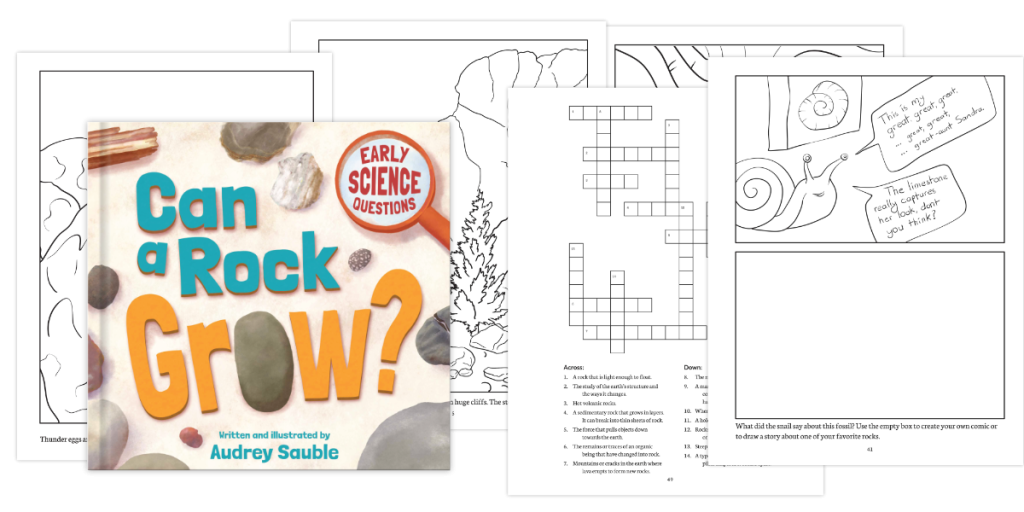
I’ve been working on some earth-shaking updates to Can a Rock Grow? (Or, at least some fun changes!) This book is a unique look at the rock cycle.
It helps kids explore geology and learn more about some fascinating stones.
Ready to dig into geology with your young rockhounds?
Last week, I shared a list of 15 different ways that people use rocks. Now it’s time to explore some hands-on science projects!
You can learn about rocks with a few easy science projects. These projects include using an acid test, a scratch test, or a density test.
Most rock identification kits include tools to test rocks and find out their properties. You can put your own kit together using these tips from The Barefoot Homeschooling Mom.
Check out these six activities for learning about geology and rock identification:
1. Scratch Test
If you’re looking at a rock, the first question is often, “What is it?” So, start off your STEM projects by putting together your own rock identification kit!
For the scratch test, your main tool is a steel nail, available at any hardware store. You can also test rocks with a piece of glass and a copper coin.
The scratch test is particularly helpful for finding out a rock’s hardness. This test allows kids to explore the main difference between several common types of rocks.

2. Make it fizzy
While the kits above use vinegar as their acid (for safety reasons), most scientists would use hydrochloric acid. Have you experimented with a vinegar and baking soda reaction? Hydrochloric acid and limestone are a different version of this reaction. Be careful using this type of acid, though! It’s stronger than vinegar.
If your kids are old enough, try testing sedimentary rocks by dripping hydrochloric acid on them. See how limestone reacts when the acid touches it.
This experiment from Preschool Powol Packets explains how to use limestone and hydrochloric acid for this experiment.
3. Weight vs Mass
If you have older kids, you can practice some math skills with your rocks!
Mass is to total amount of matter in an object. It’s measured using both weight and volume.
For weight, you’ll need a small scale. Weigh your rocks and note the weight for each.
For volume, you can use a measuring cup partially filled with water. Place each rock in the water one at a time and record how much the water level rises. This tells you the volume of the rock.
When you have both sets of measurements, compare your rocks. Two rock rocks can weigh the same, but have different volumes. This happens when the molecules in one rock are packed more densely than the molecules in the other rock. This denser rock will have a high mass, even though it has the same weight.
This science lesson from Blog She Wrote explains more about this experiment and shows how to calculate mass.
4. Crack it open
Rockhounds and scientists alike often break rocks open to study them more closely.
Note: safety glasses are extremely important when you are breaking hard objects. We’ve also found that covering the item in a cloth napkin or kitchen towel can keep pieces from flying everywhere. This makes the activity safer and leaves less mess to clean up afterwards.

For this project, you’ll need a set of geodes (or other, more common rocks), and a hammer. You can use either a regular carpentry hammer or a specialized rock hammer.
For older kids, you can use some of these suggestions for picking a good rock hammer and using it effectively. Plus, the safety tips always apply at any age!
If you are teaching younger kids, use softer rocks that will break or crumble relatively easily. You can use the scratch tests mentioned above to find soft rocks like chalk or soapstone. Or you can buy sets of geodes online and break those apart to see what’s inside.
This post from Fantastic Fun & Learning explains how even preschool kids can use real tools to break apart rocks.
Bonus activity:
In nature, rocks usually break down slowly over time. You can create your own erosion demonstration using sugar cubes and water.
This project isn’t as loud or fast as breaking rocks with a hammer. Instead, it shows how water works to slowly erode the minerals in rocks. For more instructions, check out this science experiment from Science Buddies.

5. Grow your own rocks
If you want to delve even deeper, the National Park System explains how to use Epsom salts to grow stalactites.
For this project, dissolve Epsom salts in water to create a thick mixture. Pour the mixture into two jars, then drape a string between the jars.
To dress this experiment up, you can add food coloring, like we did in the image below.
Bonus points if you use this project to talk about capillary action! If you do, you can use this lesson to explore how the string draws the liquid out of the jar.
Other ideas:
What about growing a geode, instead of breaking it? Table Life Blog explains how to use borax and eggshells to create crystal “rocks.”
Or, for a quicker project, you can use play dough or clay to create your own metamorphic rocks. For these rocks, you layer the play dough, then squish around to watch the ‘rocks’ change. Check out this fun project from The Barefoot Homeschooling Mom for more instructions.
6. Rock out with a party
Want to turn your science experiments into a party? Try baking a geology-themed treat. Hide the Chocolate’s nature book club on rocks has a variety of recipes and other party ideas.
Plus, you can combine these science activities with a number of fun children’s books. I’ve put together a list with all of my favorite children’s books about rocks and geology.
My own picture book, Can a Rock Grow?, explores the how rocks change over time (and all the shapes you can find!). You can find more information about it here!
In the activity packet below, there’s also a scavenger hunts, a sample page for a rock journal, and other ideas.
Join the advance reader team
for Can a Rock Grow?
You’ll get book updates, bonus coloring pages, STEM lesson plans,
and a chance to download the ebook for free.
Leave a Reply