I’ve been working on a picture book . . .
That means trips to raid my local library’s stash, looking for any and all books on that topic. It’s fun to see what other authors have written about that topic. And, I love seeing how many ways authors find to explore the same themes!
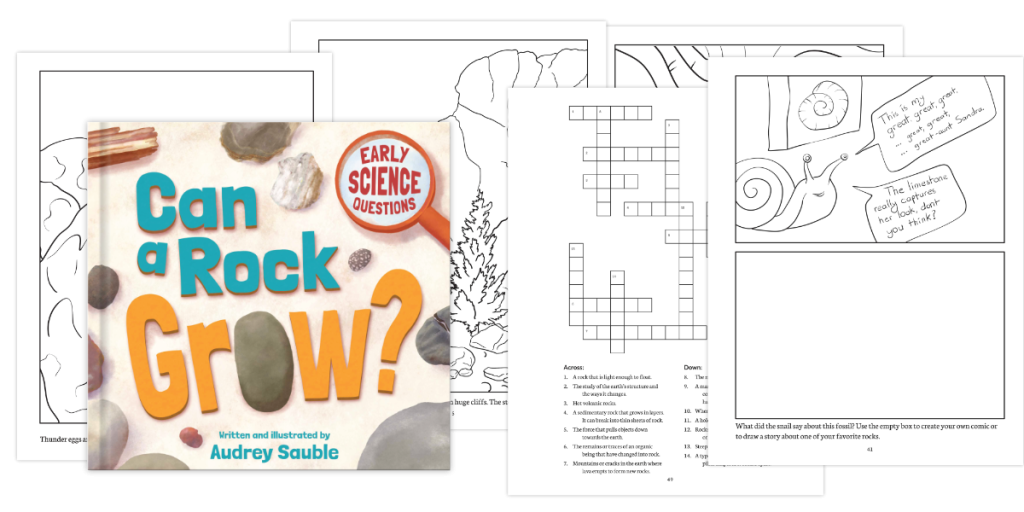
My own picture book Can a Rock Grow? explores different shapes that rocks can change over time. It’s a great tool for exploring the rock cycle.
I’ve spent the past year or two working on this book. During that time, we’ve been reading read about rock collecting, geology, and the rock cycle.

Now Available! Can a Rock Grow?
I’ve been working on some earth-shaking updates to Can a Rock Grow? (Or, at least some fun changes!) This book is a unique look at the rock cycle.
It helps kids explore geology and learn more about some fascinating stones.
After working on Can a Rock Grow?, I’ve been sharing some of what I’ve learned. That includes a list of different ways people have used rocks.
I’ve also put together a short list with a variety of geology experiments.
Now, though, it’s time to share my reading list with all of my favorite books about rocks!
(This post includes affiliate links. I earn a small commission for purchases made through these links. There is no extra cost to use these links. If you prefer to avoid Amazon, you can find most of these books and some extras on BookShop.org.)

My Favorite Picture Books:

I’m Trying to Love Rocks, by Bethany Barton. If you haven’t read the I’m Trying To Love series yet, you really should because they are fantastically fun reads.

A Rock is Lively, by Dianna Aston, illustrated by Sylvia Long. This is a great book for learning about the rock cycle and other fun rock facts.
A Stone Sat Still, by Brendan Wenzel. A fantastically simple and fun look at the rock cycle, told through the fictional role of one particular stone.

Old Rock (Is Not Boring), by Deb Pilutti. The whimsical story of one rock explaining to his friends why he’s happy to sit in one place . . . because he hasn’t always done that.
A Stone is a Story, by Leslie Barnard Booth, illustrated by Marc Martin. The riveting story of a stone’s journey from deep underground downstream, out to sea, and back again.
A Dinosaur Made Me Sneeze, by Carla Jansen. How does dust get in Martin’s nose to make him sneeze? It’s all that silly dinosaur’s fault!
If Rocks Could Sing: A Discovered Alphabet, by Leslie McGuirk. Can you find all the letters of the alphabet . . . using only rocks?

A Rock Can Be, by Laura Purdie Salas, illustrated by Violeta Dabija. A lovely book about different things that rocks can be.
Julie the Rockhound, by Gail Langer Karwoski, illustrated by Lisa Downey. When Julie finds a sparkly stone, she learns about rock collecting and different kinds of rocks.

Rhoda’s Rock Hunt, by Molly Beth Griffin, illustrated by Jennifer A. Bell. Rhoda loves collecting rocks, but sometimes there are too many for her to carry.
Everybody Needs a Rock, by Byrd Baylor, illustrated by Peter Parnall. Everyone needs their own special rock. This book explores how kids can pick one.

Rocks in His Head, by Carol Otis Hurst, illustrated by James Stevenson. The story of an amateur geologist who fell in love with rocks as a boy.
A Rainbow of Rocks, by Kate DePalma. Rocks for all the colors of the rainbow and more. This is a great way to see how colorful rocks can be.
How the Meteorite Got to the Museum, by Jessie Hartland. The journey of one special rock from space to someone’s yard to a museum.

When Sue Found Sue, by Toni Buzzeo, illustrated by Diana Sudyka. The story of an archeologist who discovered the nearly complete T-Rex skeleton. This is the famous skeleton now displayed at the Chicago Field Museum of Natural History.
The Pebble in My Pocket: A History of Our Earth, by Meredith Hooper. A longer story about the rock cycle and the Earth’s changes over time, using the story of one small pebble.
If You Find a Rock, by Peggy Christian. Did you know that rocks can be climbing rocks or skipping rocks or even memory rocks? This book is a lyrical celebration of all kinds of rocks and the nature explorers who find them.

Grand Canyon, by Jason Chin. This book takes a closer, more in-depth look at one specific region. It’s one of my top favorites, as well as the best geology book I’ve ever read.
Scavenger Scout: Rock Hound, by Shelby Wilde, illustrated by Yana Popova. An imaginative fantasy story of rock collecting.
The Wonder Rocks, by Roger Blonder. A playful look at unusual rock formations in verse, giving the rocks faces and stories.
Petra, by Marianne Coppo. Most of the other books on this list focus on science and rock identification. This one is just a fun story about a rock.

Science, Activities, and Guides:
Geology Lab for Kids, by Garret Romaine. This is a fun resource! It introduces kids to experiments and activities focused on rocks, gems, geodes, crystals, fossils, and other natural wonders.
Is Sand a Rock?, by Ellen Lawrence. A thorough nonfiction introduction to the rock cycle.
The Usborne Spotter’s Guide to Rocks and Minerals, by Alan Woolley. A simple guide to rocks and rock identification. This guide would be a great resource for younger kids.
Rocks, Fossils & Arrowheads (A Take Along Guide), by Laura Evert. A simple guidebook that introduces children to several common types of rocks.
My Little Book of Rocks and Minerals, by Claudia Martin. A fun book explaining how rocks form and what the main types of rocks are.
Rock Collecting for Kids: An Introduction to Geology, by Dan R. Lynch – a good introduction to rock collecting and identification for kids. This author has another book about fossils for kids, as well as regional geology guides for adults.
National Audubon Society First Field Guide: Rocks and Minerals, by Edward R. Ricciuti. This book is a solid introduction to rocks and minerals. It provides information about rock formation and identification. It also includes tons of other information. This book would be a good resource for older kids.
More resources:
I didn’t include my own book in this list, but Can a Rock Grow? is a fun, simple introduction to the rock cycle as well. It focuses on the different shapes that rocks can be, while showing how the rocks change over time.