

Getting ready to teach an earth science unit? Or looking to explore geology with your students?
I shared many of my favorite geology books several years ago. Since then, though, I’ve found so many fabulous new books. So, it’s time for an update!
As an author and a nature educator, I spend a fair bit of time browsing the Next Generation Science Standards. This list has books you can pair with some of the key ideas in NGSS earth science themes.
Plus, these are all fun books! I suggest checking them out if you are a teacher, a homeschool family, or a parent looking for something fun to read with your kids.

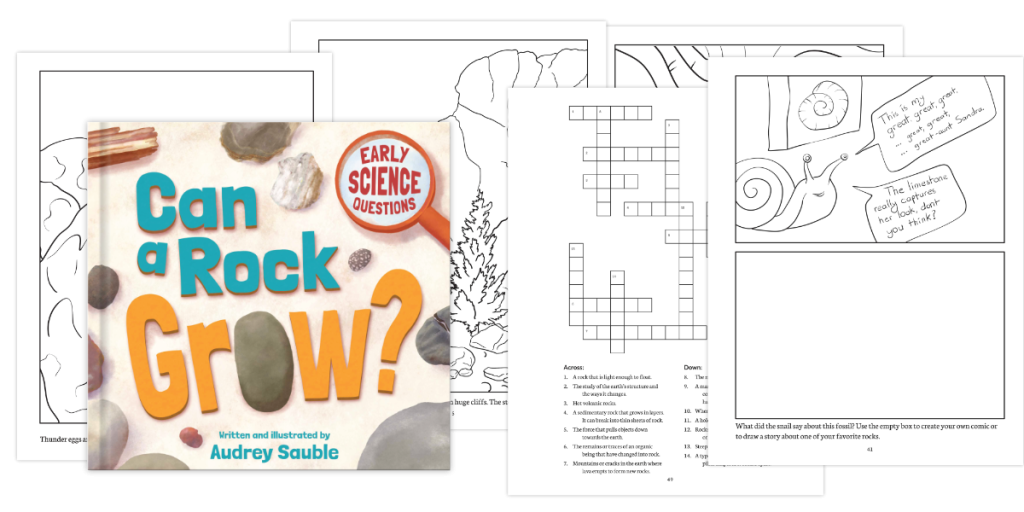
The Rock Cycle: Can a Rock Grow? by Audrey Sauble.
This is my own picture book, inspired by a rockhound neighbor who introduced my family to obsidian, thundereggs, and other fascinating rocks. This book offers kids a unique look at the rock cycle. It shows how rocks change over time, while highlight some really amazing rocks. For extra fun, you can also check out the activity book!

Earth’s History: Earth: My First 4.54 Billion Years by Stacy McAnulty, illustrated by David Litchfield.
This book shows Earth’s early years as a baby planet, slowly cooling to become the blue marble we know today. It’s a simple story, highlighting the key eras in Earth’s history.

Plate Tectonics: Solving the Puzzle Under the Sea: Marie Tharp Maps the Ocean Floor by Robert Burleigh, illustrated by Raúl Colón. Want to add a fun biography into your STEM studies? This book tells the story of a young female scientist who notices a pattern while mapping the ocean floor—and finds the answer to some ancient riddles. In the process, kids learn about plate tectonics and how giant landmasses move (slowly).

Earth’s Layers: The Street Beneath My Feet by Charlotte Guillain, illustrated by Yuval Zommer.
Beneath your feet, there’s a street or a trail. Underneath that, you’ll find pipes and wires and millions of tiny organisms. Below that, look for ancient pottery and other artifacts. But what’s below all that? This is a massive fold-out book, more poster than picture book. It gives kids a close-up look at the layers of the earth, all the way down to the core and back again!

Landforms:
I have two book recommendations for this section.
Water Land: Land and Water Forms Around the World by Christy Hale. This book is a very simple, almost wordless look at major landforms. The shapes are shown as opposites (island = lake), matching the basic shapes of land and water. It would be a great guide for showing kids how to model different landforms out of playdough.
Awesome Earth: Concrete Poems Celebrating Caves, Canyons, and Other Fascinating Landforms by Joan Bransfield Graham, illustrated by Tanie García. For older students, this book offers a little more information—told through a series of poems. While Water Land focuses on the shapes that water and land make together, this book explores continents, different types of rocks, caves, and other landforms.

Mountains: How to Make a Mountain: in Just 9 Simple Steps and Only 100 Million Years! by Amy Huntington, illustrated by Nancy Lemon.
Add some humor to your geology studies with this handbook for making your very own mountain! It covers how to get started, ways to add fun details, and tools for making your mountain truly unique.

Caves: Stalactite & Stalagmite: A Big Tale from a Little Cave by Drew Beckmeyer
What’s the opposite of a mountain? A cave! This book takes a whimsical look at an ancient pair of friends, growing together in a cave. One day, they’re knee-high to a trilobite. Will they ever be able to touch? Maybe! (Many thousands of years later . . .)

Erosion/weathering:
Grand Canyon, by Jason Chin. This book takes a deep dive into one specific region. Starting at the bottom of the canyon, a family hikes up the trail, learning about each layer of rock in turn. This book is one of my favorite picture books, as well as the best geology book I’ve ever read.

Deposition: A River of Dust: The Life-Giving Link Between North Africa and the Amazon by Jilanne Hoffmann, illustrated by Eugenia Mello.
Most of these books look at how landforms breakdown over time. This book looks at a special way that soil can move from one continent to another. It follows the air currents carrying dust from Africa across the Atlantic ocean. Then, in the Amazon rainforest, the dust settles to the ground, adding vital nutrients to the soil.

Humans using rocks: Stone by Stone: A Rock’s Journey Through Time by Melissa Koch, illustrated by Victoria Tentler-Krylov
Mostly rocks just happen–but sometimes humans use and shape the rocks. See some of the ways we use rocks as memorials, landmarks, shelter, art, and more!

Fossils: When Sue Found Sue, by Toni Buzzeo, illustrated by Diana Sudyka.
The true story of an archeologist who discovered the nearly complete T-Rex skeleton. This book tells the story of the famous skeleton now displayed at the Chicago Field Museum of Natural History. It focuses on Sue Hendrickson’s work as a scientist, but explores what it’s like to work in archeology.
Interested in other resources?
If you join my Readers’ Vault, you’ll get an activity packet for Can a Rock Grow?, as well as my other books.
Calling all young rockhounds!
Sign up now to get activity pages for Can a Rock Grow?!

Leave a Reply